
Self-Extinguishing by Design: Our Dry-Powder Fire Suppression Capacitor Patent
Patented technology · 2026-07-22 · 2 min read
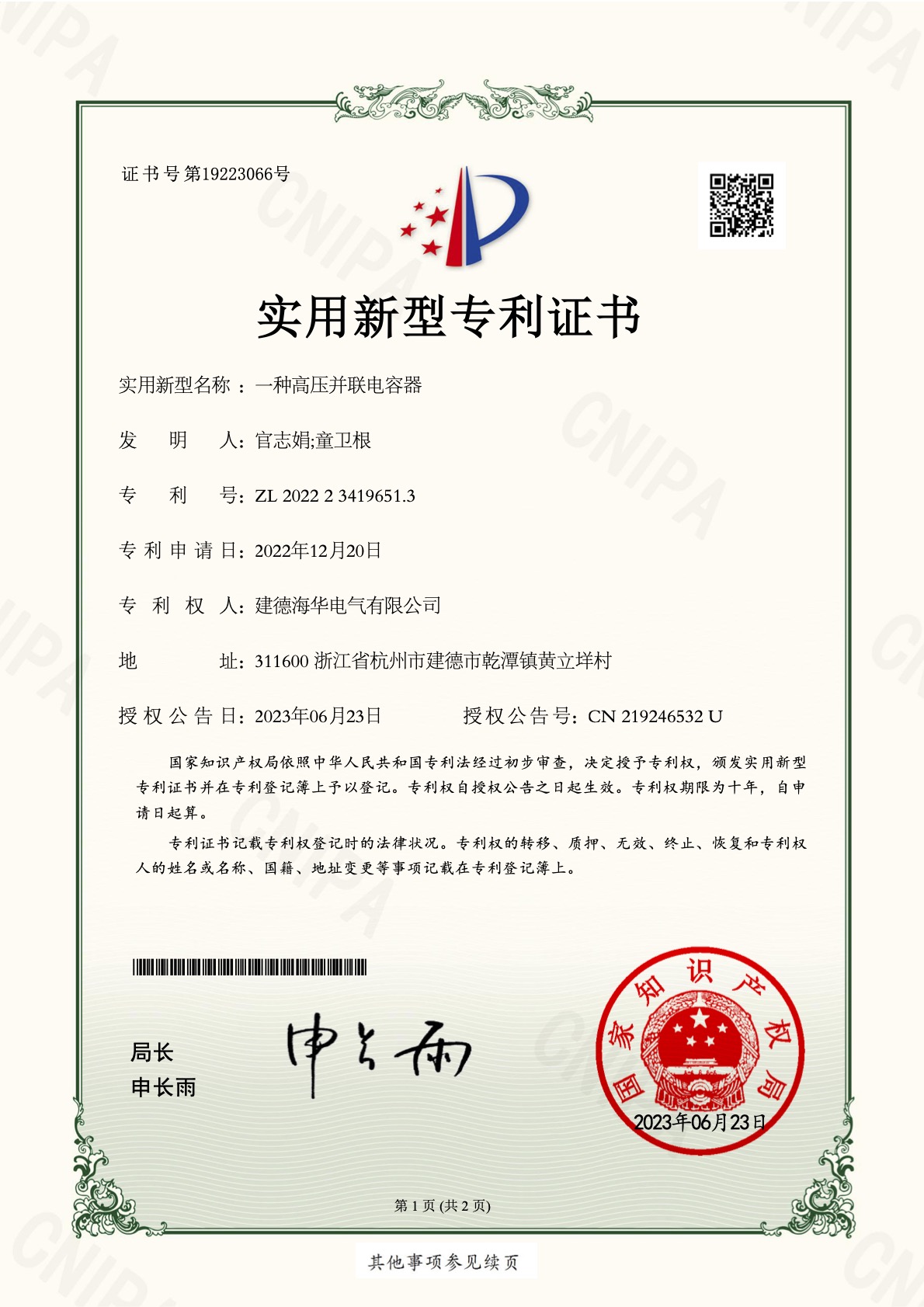
High-voltage shunt capacitors sit at the center of reactive power compensation systems, often in unmanned substations or cabinets where a fault can go unnoticed until it's a fire. Utility model patent CN219246532U ("High-voltage shunt capacitor with integrated dry-powder fire suppression," granted 2023) builds the response to that scenario directly into the capacitor housing, rather than relying only on external protection.
The problem it solves
- External suppression reacts late. Room-level or cabinet-level fire systems typically respond after a fault has already progressed.
- Unmanned sites need a first line of defense. Many capacitor banks operate with no one present to intervene manually.
- Cooling and suppression are usually separate systems. Ventilation for normal thermal management and fire response are rarely engineered together.
How the patent works
The capacitor housing integrates a mounting chamber and vent ports fitted with a fan for normal-operation cooling, alongside a dedicated fire-suppression mechanism inside that same chamber. A suppression rack filled with dry powder sits in the chamber, with two solenoid valves at its base connected to an internal cavity and slide cavity. An extraction pump, fixing hole, and mounting port are built into the rack itself, and the whole assembly is connected through to the mounting chamber. When a fault condition is detected, the solenoid valves open and the extraction pump drives dry powder from the rack directly into the chamber: a compact, automatic response that doesn't wait for a room-level system to react.
What this means for you
For substations, industrial cabinets, and other installations where capacitors run unattended, this design adds a self-contained, automatic suppression layer at the source of the risk: simple in construction, and fast to respond.