
Built-In Explosion Containment: Inside Our High-Voltage Film Capacitor Patent
Patented technology · 2026-07-08 · 2 min read
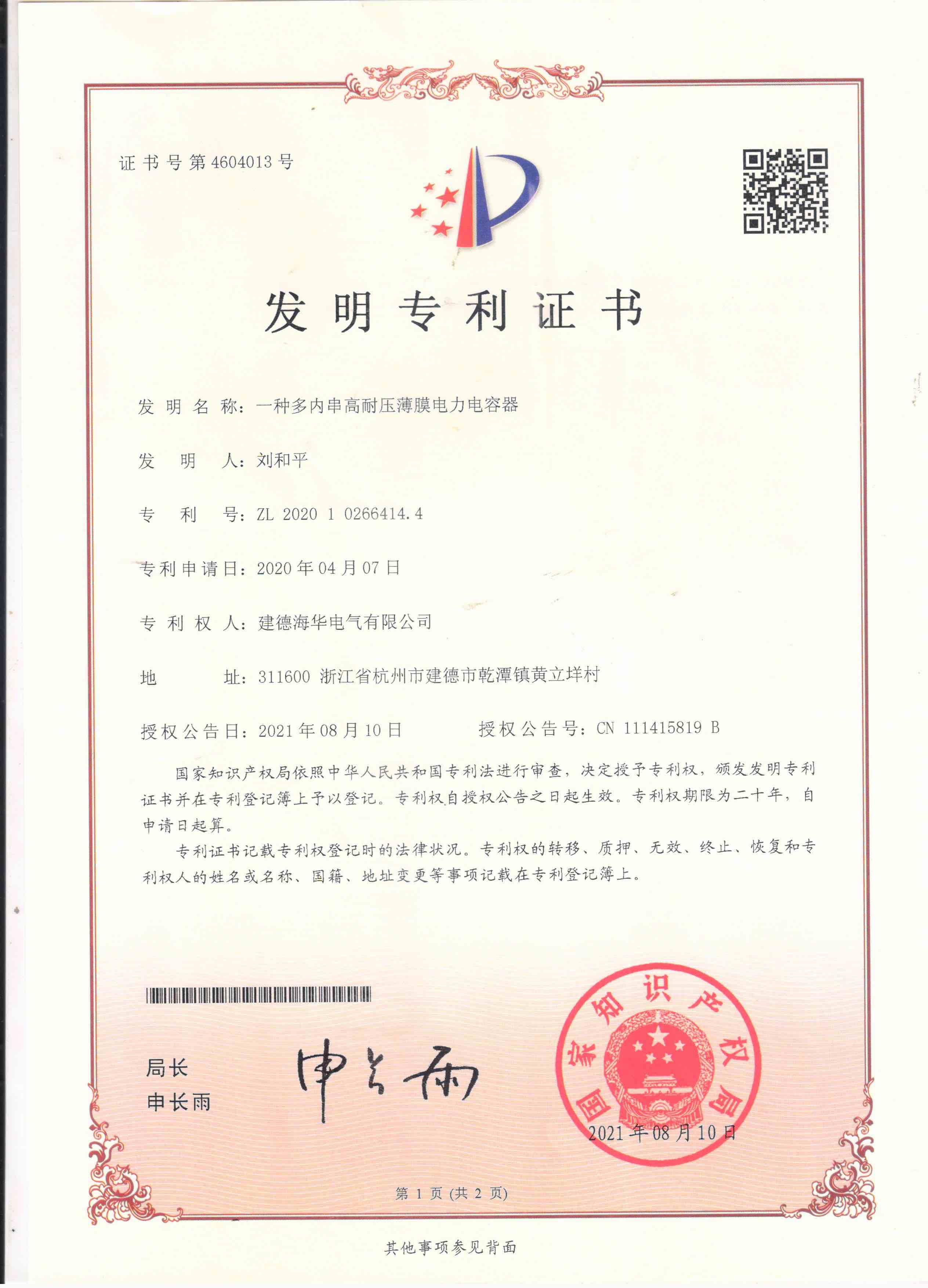
Power capacitors fail differently than most electrical components. When an internal fault drives current sharply upward, temperature and pressure inside the case can cross a critical threshold within milliseconds, and in the worst case, that ends in case rupture. In a densely packed bank, one unit's failure can damage everything around it. That failure mode is exactly what our invention patent CN111415819B ("Multi-series high-voltage film power capacitor with explosion-containment nested structure," granted 2021) was designed to contain.
The problem it solves
- Fault energy has nowhere to go. In a conventional case, a runaway internal fault raises internal pressure until the housing itself becomes the failure point.
- One failure can cascade. Without isolation between the failing element and the outer housing, the shockwave and heat from a rupture can reach adjacent components and circuits.
- Heat has to move fast. Thermal transfer inside the unit needs to keep pace with continuous load, not just survive a fault.
How the patent works
The design nests an inner panel structure inside an outer panel, joined through a composite layer and a pressure-relief mechanism. In normal operation, the inner layer gives the capacitor tube group, terminal chamber, heatsink, and control/conversion components a fast path for heat transfer. If internal pressure spikes toward a fault, the composite layer and pressure-relief panel work together so any resulting shockwave is absorbed between the inner and outer panels, rather than breaching the housing and reaching neighboring equipment. It's a structural answer to a physics problem: give fault energy a controlled place to go before it becomes an uncontrolled one.
What this means for you
For engineers specifying high-voltage film capacitors in dense banks or cabinets, this patent reflects a containment-first approach to fault handling that protects the surrounding circuit and equipment, not just the capacitor itself.