
Built-In Voltage Monitoring: Our Detachable Sensing Electrode Capacitor Patent
Patented technology · 2026-08-14 · 2 min read
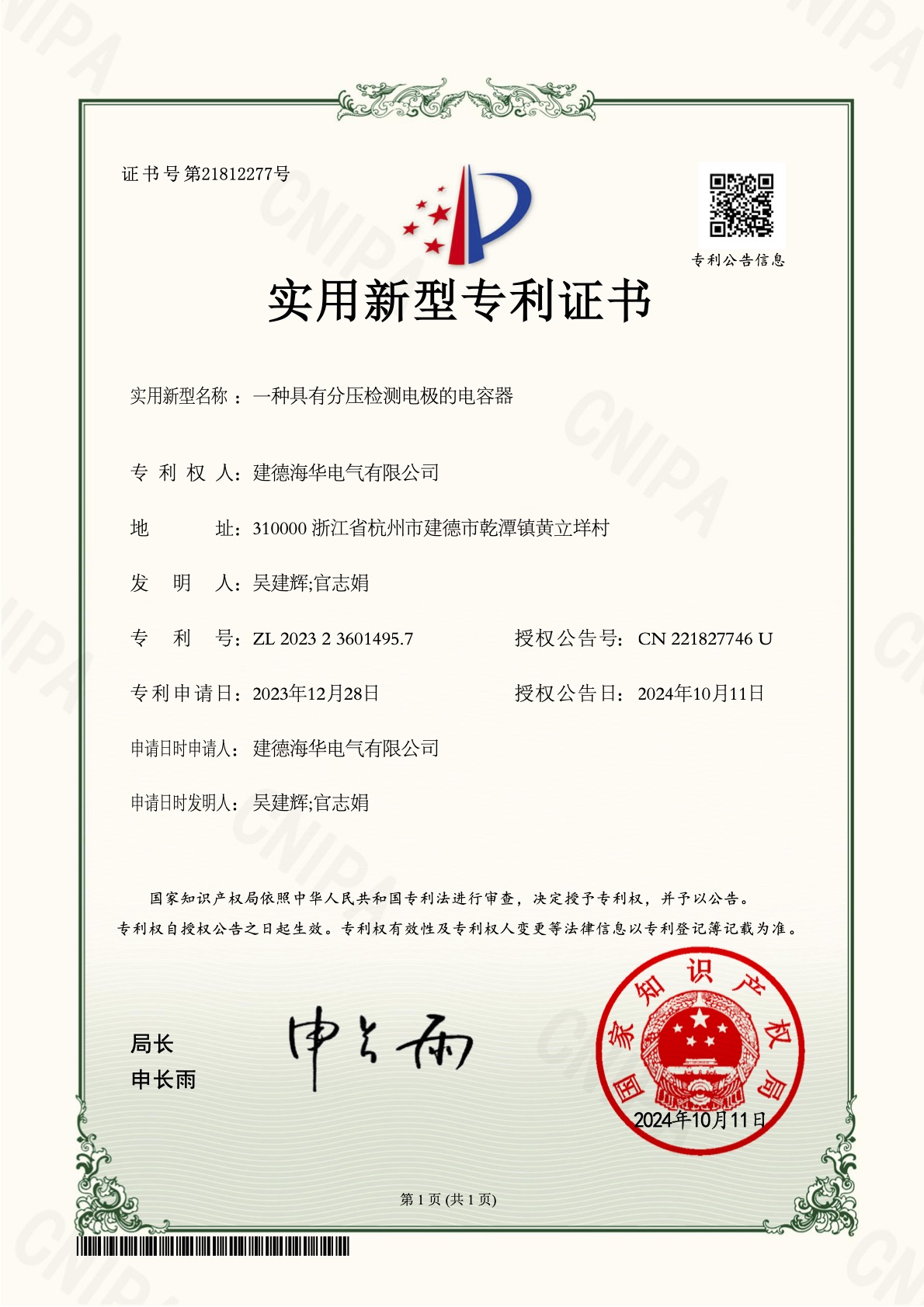
Measuring voltage across a high-voltage capacitor usually means adding external instrumentation: extra hardware, extra wiring, and another point of failure. Utility model patent CN221827746U ("Capacitor with detachable voltage-divider sensing electrode," granted 2024) builds voltage sensing into the capacitor body itself.
The problem it solves
- External voltage-divider instrumentation adds complexity. Retrofitting measurement hardware onto a capacitor bank means additional space, wiring, and mounting.
- Higher-voltage units are harder to instrument safely. Direct measurement becomes more difficult, and riskier, as voltage increases.
- Fixed instrumentation can't be swapped or serviced easily. Permanently integrated sensing hardware is harder to maintain or replace.
How the patent works
The capacitor body carries a first and second electrode on opposite sides, with a mounting slot and sensing port built into the body between them. One or more voltage-divider sensing electrodes mount into that port and can be removed or replaced independently of the main electrodes. Working together with the first and second electrodes, the sensing electrode forms a voltage-divider path that allows accurate voltage measurement on capacitors operating at higher voltages, without external divider hardware.
What this means for you
For applications that need ongoing voltage monitoring (condition monitoring, protection relaying, or diagnostics), this design gives you a sensing point that's integral to the capacitor and serviceable on its own, rather than a separate piece of measurement infrastructure to install and maintain.